
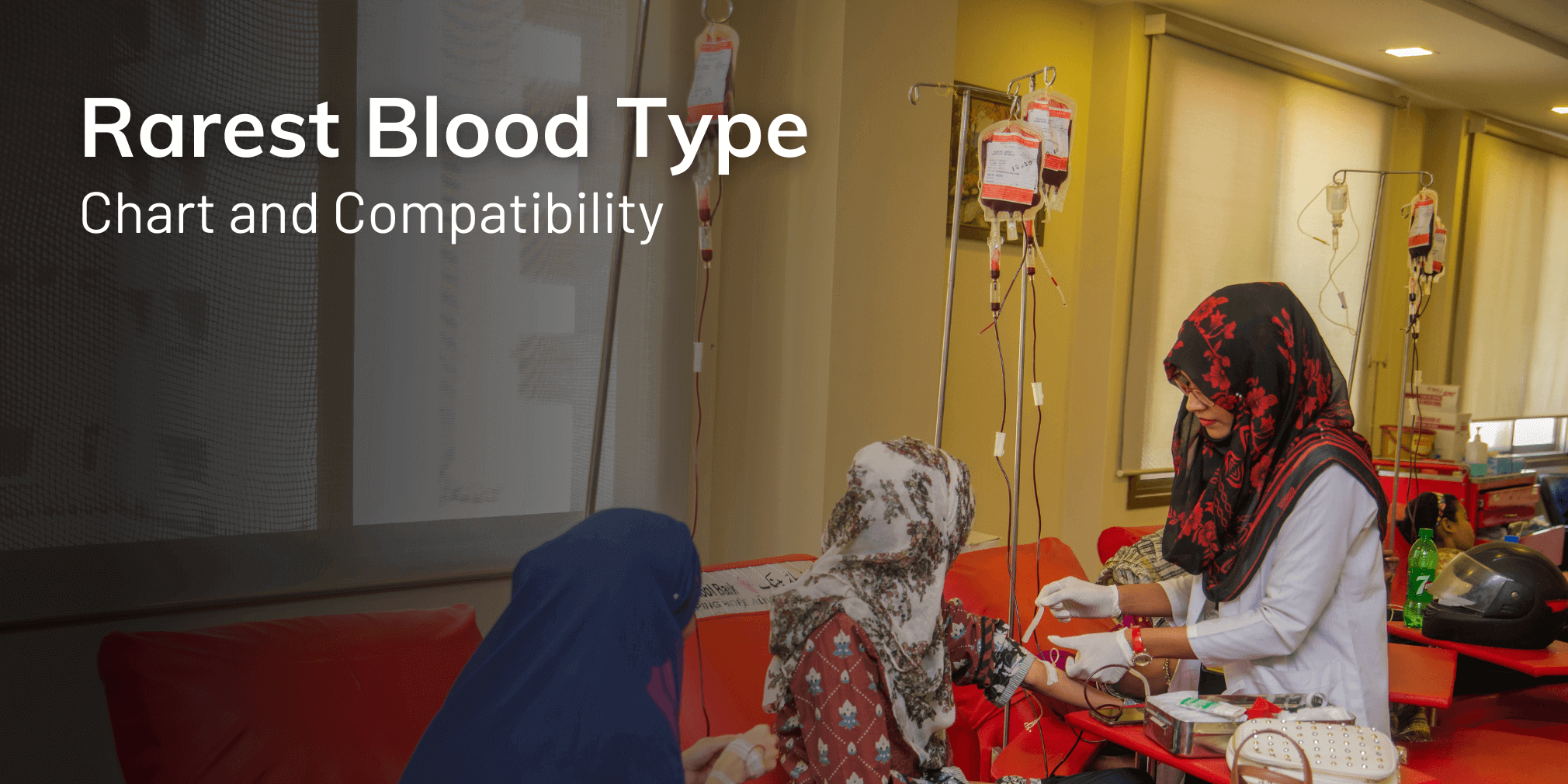
Rarest Blood Type: Chart and Compatibility
Human blood types vary across eight common ABO/Rh groups, but a few are exceptionally rare and clinically critical. The rarest blood type is Rh null, often called “golden blood,” followed by subtypes like Bombay (HH) and AB–.
This guide explores:
- What makes Rh null golden and rare
- Other rare subgroups like Bombay blood
- A clear blood type compatibility chart
- Compatibility specifics: O blood group can receive from…, O+ can donate to…
- Roles of the universal donor and the recipient.
What Is the Rarest Blood Type?
Rh null (“Golden Blood”)
- The rarest known blood type, with fewer than 50–60 individuals worldwide.
- Lacks all Rh antigens (D, C, c, E, e), meaning it carries none of the ~61 Rh proteins.
- Can donate red cells to any Rh-negative recipient, but Rh null individuals can only receive Rh null.
- Its scarcity makes it invaluable. Only a handful (≈9) are active global donors; units are often frozen for emergencies.
Bombay Phenotype (HH)
- Extremely rare: ~4 per million globally, but ~1 in 10,000 in Mumbai.
- Lacks the H antigen, meaning they cannot receive from any typical ABO group; even O.
- Can only receive from other Bombay phenotypes; their units are essential for themselves and a few others.
AB–
Rarest of the standard eight types (~1% globally).
They are universal plasma donors and can receive red cells from A–, B–, AB–, and O–.
Why Rarity Matters
- Transfusion risk: Only exact matches prevent dangerous immune reactions.
- Fixed pools: Rare-type blood is frozen and reserved for emergencies; donations are tracked internationally.
- Research value: Rh null blood informs scientists about Rh proteins and red cell biology.
Blood Group Compatibility Chart
The table below uses checkmarks (✅) to show red-cell compatibility:
| Donor ↓ / Recipient → | O– | O+ | A– | A+ | B– | B+ | AB– | AB+ |
|---|---|---|---|---|---|---|---|---|
| O– | ✅ | ✅ | ✅ | ✅ | ✅ | ✅ | ✅ | ✅ |
| O+ | ❌ | ✅ | ❌ | ✅ | ❌ | ✅ | ❌ | ✅ |
| A– | ❌ | ❌ | ✅ | ✅ | ❌ | ❌ | ✅ | ✅ |
| A+ | ❌ | ❌ | ❌ | ✅ | ❌ | ❌ | ❌ | ✅ |
| B– | ❌ | ❌ | ❌ | ❌ | ✅ | ✅ | ✅ | ✅ |
| B+ | ❌ | ❌ | ❌ | ❌ | ❌ | ✅ | ❌ | ✅ |
| AB– | ❌ | ❌ | ❌ | ❌ | ❌ | ❌ | ✅ | ✅ |
| AB+ | ❌ | ❌ | ❌ | ❌ | ❌ | ❌ | ❌ | ✅ |
✅ = Compatible donor–recipient pairing
❌ = Not compatible without high cross-match risk
Breakdown by Keyword Queries
Blood Types and Compatibility
- Compatibility depends on ABO antigens (A/B) and Rh factor
- Red cells must not contain antigens that the recipient has antibodies against.
O Blood Group Can Receive From
- O–: can receive only from O– (no A, B, or Rh antigens).
- O+: can receive from O+ and O– (Rh– acceptable to Rh+).
- Check the chart above for full specifics.
O+ Blood Group Can Donate To
- O+ can donate to O+, A+, B+, AB+ (all Rh‑positive).
Universal Donor and Recipient
- Universal red-cell donor: O–, as it lacks all A/B/Rh antigens.
- Universal recipient: AB+, as it carries both A/B antigens and no anti‑A/B antibodies.
- For plasma, roles are reversed: AB gives to all, O receives from all.
Rare Blood Types: Summary Table
| Blood Type | Rarity | Donor Recipients | Unique Restrictions |
|---|---|---|---|
| Rh null | ≈1 in 6 million, <50 cases globally | All Rh‑negative, but ONLY its own type | Universal among Rh–, but needs its own blood for transfusion. |
| Bombay (HH) | 4/million (global), ~1/10,000 in Mumbai | Only Bombay phenotype recipients | Cannot receive any ABO; donation pools are ultra‑small |
| AB– | ~1% globally | A–, B–, AB–, O– | Universal plasma donor |
How Rare Antigen Subtypes Affect You
Beyond ABO and Rh, over 600 antigens exist across ~47 blood group systems. Some subtypes, like Ro, Kell-negative, Jka–b–, SARA—, are rare but critical for chronically transfused patients (e.g., sickle cell disease). Compatibility requires extended antigen matching.
Why This Matters
- Mismatched transfusions cause hemolytic reactions, sometimes fatal.
- Hospitals maintain rare‑blood registries and frozen stocks; Rh null & Bombay types are often stored internationally.
- Donors with rare types are invaluable; regular donation and registry membership help maintain lifesaving reserves.
What You Can Do
- Know your blood type: as a donor, it could be critically needed.
- Individuals with rare types should join rare-donor registries and schedule regular appointments.
- At Husaini Blood Bank, we offer full blood typing, extended antigen testing, and inclusion in rare donor programs. Visit our Lab Test page to check your type and compatibility today.
FAQs
Q: What is the rarest blood type?
A: Rh null (“golden blood”), at ~<50 known worldwide.
Q: Is AB– the rarest common type?
A: Yes, only ~1% of global donors.
Q: Who can O+ receive from?
A: Both O+ and O– donors.
Q: Where does O+ donate to?
A: Any Rh-positive type: O+, A+, B+, AB+.
Q: Who is a universal donor/recipient?
A: O– is a universal red-cell donor; AB+ is a universal recipient. For plasma: AB gives to all, O receives from all.
Understanding rarest blood types like Rh null and HH, alongside a clear blood type compatibility chart, empowers both donors and patients to prepare for safe transfusions. Knowing specifics, such as what O blood group can receive from and where O+ can donate, is vital in emergencies.
At Husaini Blood Bank, we’re committed to advanced blood typing, rare donor support, and transfusion safety. Get your blood group chart, understand your compatibility, and consider joining our rare-donor registry; you could save a life today.